Wednesday, 11 April 2018

The Market, Part Two

In February, I published the first in an intended series of three blogs about my experience on the academic job market. In that post, I discussed my journey through graduate school, and I outlined the general tiers of academic institutions. In this post, I will discuss the rankings of paid academic positions, and then provide templates for my own materials that I used on the job market. Again, I in no way claim to be an expert in these matters, and I explicitly say that not to devalue my own experience but to qualify it as just that-- experience. In many ways, the academic life can be somewhat bipolar in that it asks professors and students to choose areas of research and scholarship that interest them, but it also, often, pushes away personal time, agency, and care. I believe that scholars must and should work to claim and exercise their own agency through this journey, and that is grounded in experience.

So, this is my experience on the academic job market.

Academic jobs in English, rhetoric, and writing come out one time a year, and they mostly come out on one list. This is so opposite of what normal people experience in the job market, but it's the reality of our field (and, I believe, many other academic fields). This list is called the Modern Language Association of America Job Information List, or the MLA JIL. This list is published in mid-September, and it contains the majority of the job postings in the entire field for the upcoming (read one year away) academic year. Now, there are some pre-JIL postings that sometime come out prior to this date, and those are usually on individual listserves or on the Rhetoric/Composition Wiki. Jobs are also continuously posted on HigherEdJobs and ChronicleVitae. One other place where job ads are aggregated is on Rhet Map, which draws the adds from the MLA JIL and shows them according to location. Jim Ridolfo puts this together, and it is a great service to job seekers.

I used all of these resources to search for job postings. From about mid-August to mid-December I looked at one or more of these lists probably at least four days a week. The Rhet/Comp Wiki is especially helpful/problematic to check because it can be updated by community members who log on and update the individual adds with the status of their applications/ interviews, etc. To the right is one example of a post on the site from my alma mater, ASU.

These job lists come out and they list a variety of items that you can also see in this example. Items like, the title of the position, the focus of the position, a description of what the ideal candidate will focus on and/or do, the deadline for submission of materials, and sometimes (not in this case) a list of materials that the committee would like to see from the candidate. To find that information for this position the candidate would have to click on the actual link where the job is posted, in this case ChronicleVitae, in order to see what materials they need to submit for the job. I will discuss those materials coming up.

One of the most important items that these job ads list are the title of the position. In this case, the title of the position is "TT Asst. Professor." What that means is this position is listed for as a Tenure Track Assistant Professor position. Here is a list of the different kinds of teaching positions that one will generally encounter at American institutions of higher education:


Now, there are, of course, exceptions to these rankings, contract, and promotion systems, which I why I labeled them all starting with "generally." While adjuncting is by far the most tenuous and underpaid type of professorship, some institutions, like Madison College, have built in pay advancement systems. One of the main issues with being an adjunct, though, is that one only gets work if there are classes available that full time professors don't want or need. Instructors or lecturers still generally teach very heavy course loads (as many as 5/5), but their contracts are usually yearly, so there is a bit more stability; some of these positions also have internal ranking and promotion systems. Assistant, Associate, and Full professorships are the types of professorships that are most generally known to the public and considered "tenure track," although there are exceptions to this system as well. An Assistant Professor, despite the name, is a full-time professor who is part of whatever type of promotion system (tenure or non) that the institution uses. In a tenure-track system, by the time one is an Associate Professor and almost always by the time/ as one becomes a Full Professor, they are tenured and no longer tenure track.

Clicking over to Facebook just after writing the proceeding paragraph, I see that Dr. Karen Kelsky of The Professor Is In has shared this article published today (April 11, 2018) in The Chronicle of Higher Education, which asks in its title "How Much Did Professors Earn This Year?" To find specific earning statistics at any given university, take a look at Chronicle Data. The article answers that question with the following statements:

"Full-time faculty earned an average of 3 percent more than they did in the prior academic year. But the salary increase was cut by nearly two-thirds, to 1.1 percent, after adjusting for inflation. The average salary ranged widely, depending on rank: Full professors earned $104,820, associate professors made $81,274, and assistant professors took in $70,791. The average pay for lecturers was about $57,000 while, for instructors, it was $59,400. The AAUP's analysis also found salary compression at 892 institutions" (June). 

Some other troubling findings published in this article are the fact that "93 percent of all reporting institutions pay men more than women at the same rank... on average women made 90 cents on the dollar compared to men at the same rank this year" and with "the average age of a Ph.D. completion at 32," career trajectory starts much later "than most white-collar workers" (June). This is the state of the academic world that hopeful applicants, like myself, are currently entering.

In terms of what types of documents that job search committees actually want to see, there is also quite a range. Each committee wants to see something a little different, so each application takes quite a bit of time to gather and send the specific documents to the submission portal for that school. I was lucky enough to have friends and colleagues who shared their materials, so here are some of my material templates that I sent out in my job applications this past fall of 2017:

Like I said, I had many friends who supported me in this application process. One friend is Dr. Kat O'Meara, an Assistant Professor Rhetoric and Composition and Director of Composition at Emporia State University. During her application process, she wrote a blog post for 4Cs called "Managing PhDTSD." This article was very helpful to me as I jumped into my job application process.

That's it for my second market post! Now please enjoy these cute photos of my dogs because they are cute:

FINLEY

LACY


Tuesday, 20 March 2018

CCCC 2018, A Reflection

I'm putting a brief pause of my series of three job market posts, as the timing overlapped with my time spent at the 2018 Conference on College Composition and Communication in Kansas City, MO this year. I want to reflect on my time and conference experience here, and then my next post will continue the job market discussion. In addition to this post, I did document part of my conference time on my Instagram page.

This was my fifth CCCC conference, but it was a unique year. Even before the conference was held, the site of the meeting was highly contested due to the Travel Advisory for the State of Missouri put out by the NAACP-- the first ever of its kind. Despite the travel risks and concerns for many who would be traveling to the conference, the decision was made for the conference to be held in KC. With that foregrounding, there were a lot of conversations and expectations for this conference even before arriving. While the Program Chair, Asao Inoue, and the local arrangements committee did seem to put forth an effort to acknowledge these realities by having local activists come to speak and organizing a "cultural event" in the Marriott ballroom, the entire conference felt like it missed the mark on the kind of acknowledgement of social realities and activist work that it claims to do.

One effort that I was a part of was the NCTE CCCC Social Justice Task Force donation table for local organizations, spearheaded by my friend Casie Moreland. There were four of us on this particular extension of the task force, and we spent many days meeting over Skype and planning for the table prior to Cs, and then we helped staff the donation table throughout three of the four days at the conference. We were set up in the Action Hub of the conference, and we met and interacted with a lot of people walking by and at the tables around us. We raised money on laptops at the table for these six organizations:

I enjoyed working on this task force, and one of the highlights of the conference was hearing some of the activists from these organizations speak. On Thursday afternoon there was an All-Convention Event held in the Kansas City Convention Center, where three community leaders spoke to the attendees. We heard from Gillian Helm, the Executive Director of Literacy KC, Alvin Brooks, the founder of the AdHoc Group Against Crime, and Glenn North, the Director of Education and Community at the Black Archives of Mid-America. Mr. North recited his poem "Lynch Family Blues." It was poignant, heartbreaking, and beautiful. Tears rolled down my cheeks. This was the kind of thing we needed to be hearing and discussing. 

I did enjoy my time at other parts of the conference as well. I stayed in the conference hotel this time, which allowed for easy access to panels and other events. I got to see a lot of wonderful friends from Arizona State and other schools, and I attended some really engaging panels. I attended a panel on Friday morning called "Feminist Rhetorics and Digital Humanities: Challenges and Opportunities." At this panel, I heard both Jaqueline Jones Royster and Gesa Kirsch, the authors of the book Feminist Rhetorical Practices, speak about their current projects and research. I based the majority of theoretical discussion in my dissertation on this book, so it is always really neat to see them in person and hear their ideas. I also attended panels on food literacies and food justice. 

I presented my own work based on my dissertation. This presentation was called "Student Language and Identity Pathways: Genre Choice in a Feminist Writing Classroom." I presented this as a poster presentation on Thursday, March 15th. I had several people stop by and ask me about my poster and dissertation work, and I got to chat with other women who were presenting posters near me. I presented a poster once before at Cs, and I enjoyed presenting my dissertation data visually in this format again. Here are some photos from my poster presentation:

Ready to present!

Friends "reading" my poster

My session in the program

My poster board setup

I attended Cs over my spring break, but now I am back home and back in the classroom. I've enjoyed getting to know my students this semester, both in Technical Reporting and English 2. I think my students are enjoying their semester as well, as even my 7:00AM class voted to meet when I told them they could have the day off! My in-person Writing Center tutoring has also been going very well. I met with a student yesterday who pushed back on some language I was suggesting in a personal narrative, and I loved our discussion that followed about how we represent ourselves in written work and how our writing needs to feel true to our experience. 

International Women's Day was on the 8th of this month, and I celebrated by expressing gratitude and appreciation to the women in my life, as well as by getting a cupcake at a local bakery co-owned by a woman. But, let's be real, I'll take any excuse to eat a cupcake! I posted this quote on my Instagram that day, as it is one of my very favorite quotes. Time with my wonderful academic community of women at the conference also reminded me how essential the support of women is in my life! 


Monday, 19 February 2018

The Market, Part One

Snowy Day in Cottage Grove, WI
When I initially set out to write about my experience on the job market I figured I would do a quick blog, give some advice, and then wrap it up. As I sit in my office on this snowy day in late February, though, I realize that what I have gone through the past six months can't just be summed up in a quick advice blog. I don't claim to be any kind of expert on the job search or academia in any way; instead I follow the advice of those who are experts in the field, like Karen Kelsky, Ph.D. who runs The Professor Is In and wrote a book by the same name. While I don't claim to be any kind of expert, I do realize that the work and struggles I've faced over the past six months in my job search may be helpful to relay to others who are unfamiliar with this field or perhaps are starting on a similar journey to my own. As I reflect, I have realized that my current decisions do have a lot to do with decisions that I've made over the past ten years, opportunities that I've been given, and the realities of the academic market. So, in what I'm now planning as a three part series, I will begin my first post by giving some background on the realities of working as a Ph.D. in the humanities and discuss my personal journey that has gotten me to this point.

Here we go.

The Academic Market

Within academia it is no secret that secure jobs for Ph.D.s are few and far between. According to the most recent MLA Report on the Survey of Earned Doctorates, these are the statistics of job acquisition specifically of Ph.D.s in history and the humanities in 2014 (the most recent collection of data reported):

"Of the 1,533 doctorate recipients in letters in 2014, 1,293 reported their postgraduate status. Of that number, 47.1% reported having definite employment at the time of graduation, 7.1% had definite postdoctoral study, and 41.9% were seeking positions."

In a field where over 40% of graduates are looking for jobs, it is clear that a Ph.D. is no guarantee of employment. This issue is compounded by the number of Ph.D.s who graduate in a year. Professor Sharon O'Dair says:

"In its annual reports, the MLA separates doctorates in literature from those in rhetoric and composition, creative writing, and speech and rhetorical studies; if you total all of those, the current numbers are closer to 1,200 per year."

An article in The Atlantic discuss the amount of time it takes to earn a Ph.D. in the humanities. In this article, Laura McKenna says that data collected between 1994 to 2014 insinuates that humanities Ph.D.s are taking a median time of 10.70 years. McKenna goes on to say:

"Consequently, more than 12 percent of Ph.D.s complete their doctoral programs with over $70,000 of combined undergraduate and graduate student-loan debt."

Things aren't looking great! On top of these statistics, though, there are countless stories of fatigue, overexertion, and gendered, raced, and socially marginalizing realities in the academy. In her article "Why I Collapsed On the Job," Katerina Bodovski tells the story of working to the point of literal, physical collapse once she got a job. She writes:

"My job description stipulates that I should spend 60 percent of my time on research, 30 percent on teaching, and 10 percent on service"

Yet, Bodovski talks about a reality of spending nearly 100 percent of her working time on tasks that would fall under teaching and service, yet her job depended on her keeping up with the research component of her work. This created an untenable situation that she could no longer physically or mentally cope with prior to her physical collapse. She is back at her job now, but she says that she wrote this article because she "lost the ability to help herself" and she wants to warn others against that same silent, sneaky fate.

Now, I include all of this just to set the stage for the job market that I willingly chose to enter in August of 2017. I was made pretty well aware of these realities during my first semester of my MA in English Studies at Illinois State University. In that semester I took a required course called ENG 401: Introduction to Graduate School. My professor was Dr. Christopher Breu, and I have since called him "the professor that tells the truth." In that class, he told us, this work is not worth doing unless you love it. He, obviously, does love it, but his point was that the quality of life, return on time investment, and compensation of most jobs does not equal the time and effort put into obtaining the degrees necessary to do this work unless we intrinsically value the work itself.

My Personal Journey

Downtown Bloomington, IL
While I did not go into the field of Rhetoric and Composition unaware of the challenges that exist, but I probably did come in slightly naive. I made the decision to continue in my MA program even after taking Dr. Breu's class, and then halfway through I applied to Ph.D. programs. My decision had been made, but it was not always easy. I remember nights during my MA of sitting up late at my computer just crying that I'd never get my work done, let alone get through my program. I remember moments waiting by bus stops on ASU's campus choking back tears because I didn't know if this was the right choice.

On the other side of the Ph.D., though, I've had time to reevaluate and really consider what it is that is important to me. Also, because of some wonderful advice and the amazing support of my husband, I have had the privilege to be able to consciously skirt around some of the time and financial struggles that many face. When I was applying for graduate school one of my professor's at Olivet Nazarene University, Dr. Rebecca Belcher-Rankin, told me that I should never earn a degree without an assistantship. I took that advice very literally, and I chose my schools based not only on where I was accepted and had strong programs but on the assistantships that they could offer. That brought us to the cornfields of Bloomington-Normal, IL and to the beautiful desert of Tempe, AZ.

I took one year off in between my BA and starting my MA. I had gotten married the August following my BA graduation in May, and I took that year to spend time with my husband, to adjunct at my alma mater, and to apply for graduate school. I applied to maybe ten schools' literature programs, and I was accepted at Illinois State University, University of Colorado-Denver, and Northwestern State University. I received an assistantship offer from ISU, so I went there. It was a fairly easy decision to accept the offer of a paid for, two year program. It turned out to be a great choice because after one semester in the literature focus of the English studies major I decided to switch to the Rhetoric and Composition focus, and I could do that without losing any time or credits. That made the decision to switch concentrations easy, and that is probably one of the best decisions I've ever made because it set me up to study texts and people that I am really passionate about and opened up more job opportunities than those that are typically available for literature Ph.D.s.

The decision to accept the offer to get my doctorate was a little more tricky. We were living in Bloomington, IL, and I applied to three schools for my Ph.D. This is far fewer applications than one would normally send out, but I only applied to schools in places that my husband and I both wanted to live, and I really had the sense that if I was meant to get my Ph.D. then I would be accepted at one of the three schools. During my final two semesters at ISU while I was taking classes, teaching, and writing my thesis, I was applying to these schools. I applied to the rhetoric and composition programs at University of Colorado-Boulder, University of Madison-Wisconsin, and Arizona State University. I was not accepted at Boulder, I was waitlisted at Madison, but I received an acceptance and full assistantship (i.e. I didn't pay tuition and was paid a stipend to teach) from ASU. I cried when I received the acceptance, and that reaction showed me that this really was what I wanted to do.

Outside of Phoenix, AZ
Wade found a job in Tempe, we packed up our house, and we drove out to Phoenix, AZ in July of 2014. We couldn't have picked a hotter time to move, and I began to truly understand the phrase "baptized by fire." I liked my program and started to feel at home on the campus but then about halfway through the fall semester I hit a wall. The temperature was hot, and it wasn't getting cooler, and I suddenly felt aimless and very far from home. I also felt pretty physically sick, and panic started to overtake me every night. At one point, I truly thought that by Christmas of 2014, we'd be packing up and moving back to the midwest.

This was a tough but necessary turning point for me. I had carefully considered my decisions and options up until this point, but these weeks of what I call my "Extensional Crisis 2.0" (the first one was in college in 2010) made me truly evaluate and decide what it was that I wanted. Wade was my rock. At one point he had to come home from work to literally help me get out of bed. That was how weak and anxiety ridden I was, but with his and others' help I slowly started to get better. I went to a naturopathic doctor, took a food test, and started to eat differently, which helped my body heal. I also started doing yoga everyday, and I began to use and diffuse essential oils, which helped my anxiety abate. These physical changes, coupled with the decision that I would finish that first semester and then reevaluate, got me to where I needed to be. In fact, by the first weekend of November I came home to WI for a friend's wedding, and though I enjoyed my time in the fall breeze and with family, I was ready to go back to the desert after the week was over. By then time my plane touched back down in Phoenix Sky Harbor I knew I was home, and I knew that this was really what I wanted to do.

Helping Myself

When I went through my first existential crisis in college, I needed a lot of help. I credit my then professor and mentor Dr. Kristy Ingram with being the lifeline that pulled me back. She offered me sage advice, gave me dinner when I didn't eat, and was a listening ear as I questioned and debated really, everything I'd known to be true. I will be forever grateful to her for that.

When I hit my second existential crisis, I definitely still needed help. All of the things that I listed above were life savers and really shifted my daily routines and habits in positive ways that I still practice today. What I learned, though, was that I could either let this Ph.D. eat me alive, or I could begin to help myself, like Bodovski suggests above. I knew that I needed to find and then stick to my own path to be able to finish my degree.

My Meyers-Briggs personality is ENTJ. Now, I know some people (including my husband) don't see a lot of value in tests like these, but I love them. I think they reveal so much about myself and other people, and even more interestingly, the way that people react to one another. ENTJ stands for Extrovert, Intuition, Thinking, and Judging, and together that reveals the following:


Based on this personality type, it's clear that advocating for myself is not a struggle. It is actually something that comes pretty naturally to me, and something that I am not afraid to do. That being said, it wasn't something I'd ever really realized that I could or should do, specifically in a Ph.D. program where the path was seemingly already predetermined for me. I think it is no coincidence that this revelation came to me just as I was being immersed in feminist theory and pedagogy. I think that one of the reasons that feminist causes and discussions are so close to my heart now is because I saw the efficacy and necessity of them in my own life, even in a very privileged setting.

Once I realized that I needed to start acting on my own agency and as my own best advocate, I started to prioritize what I really wanted. The first thing that I knew that I wanted was to graduate in three years. My assistantship was for five, and I had up to ten (I think) to finish but based on goals that Wade and I had together, I wanted to finish coursework and my exams in year two, and I wanted to graduate at the end of my third year. I did do these things, but they would not have been possible without the help and input of Demetria Baker, the Writing Programs administrator, Dr. Maureen Daly Goggin, my chair, and Drs. Elenore Long and Patricia Boyd, my committee members. Their support and willingness to help me get through on that timeline is really what made it possible.

Next, I had to decide what type of institution I wanted to aim to work at. In higher education there are general tiers or rankings of institutions, which has to do with reputation, funding, and the research versus teaching expectations of the professors. Teaching load is assigned by how many classes a professor teaches in a semester, i.e. 2/1 means teaching two classes in the fall and one in the spring. The rankings draw upon The Carnegie Classification of Institutions of Higher Education that lists institutions according to the highest degree level that they produce, as well as the annual (since 1983) publication from US News & World Report that ranks the top 200 or so schools of the approximately 2,500 accredited institutions of higher education in the United States. The rankings of higher education are somewhat debated, but Dr. Karen Kelsky breaks them down this way:


One academic reality is that scholars are never hired at a school that is ranked higher than the one where they earned their degree. ONU falls somewhere between a middle ranked SLAC and regional college. ISU has recently moved into the rank of an R1, and ASU is an established R1 school that is listed 60th overall on the Best Graduate English Programs list in the 2017 US News & World Report. If I had wanted to aim for a job at an R2, I would have needed to spend a significant amount of time and energy on publication. If I wanted to aim for anything below an R2, I felt that I could move more quickly through my program and focus on teaching certificates and experience.

After my long, rambling discussion, it's probably fairly obvious what path I chose. Though the market is getting more and more competitive and often even the middle ranked SLACs require multiple publications, on the advise of my chair and in alignment with my gut feeling, I decided to move quickly through my program and put publications on the back burner. I did keep up my conference activity, which is another component of scholarship.

Views from Fem/Rhet in Dayton, OH
I had two basic reasons for this choice. The first reason  boiled down tremendously to my undergraduate experiences at ONU. I've written in this and many other posts about the impact and influence that my professors at ONU had on me. My college experience was so exceptional educationally, socially, and for the work that I wanted to do in the future. I knew that this was the kind of place that I wanted to teach.

Secondly, while I do like to research and study, it is not my primary passion. I can do research, and I do like to learn and grow in new areas and ideas in my field, but researching is not what gives me energy and fuels my drive. At the Feminisms & Rhetorics conference this fall, one of the most influential moments was in the feminist workshop where they asked us to identify our feminist superpowers. I identified mine as "facilitator," and since the conference I have often thought of how much that rings true. And when I teach, I get to facilitate. Every new semester I get excited about putting together syllabi and preparing the classes for my students. I also like the energy of being with my students in the classroom and sharing ideas with them and truly learning from them. Teaching energizes me. Talking about ways to teach better and instruct better energizes me. I love to teach. And after all this, I know it's what I want to do! Thanks, as always, for reading.


Thursday, 18 January 2018

A New Year

This isn't going to be the most academic of my posts, but I feel like the break over Christmas and the New Year almost counts as part of the school year because it is sandwiched between the two semesters. This year Wade and I enjoyed celebrating Christmas with both of our families here in Madison, and then we took a wonderful trip over the new year! We traveled to Spain and then took a cruise on the Norwegian Spirit to other Spanish ports and Morocco! We had a really great time. I have included a few pictures here from our time abroad.

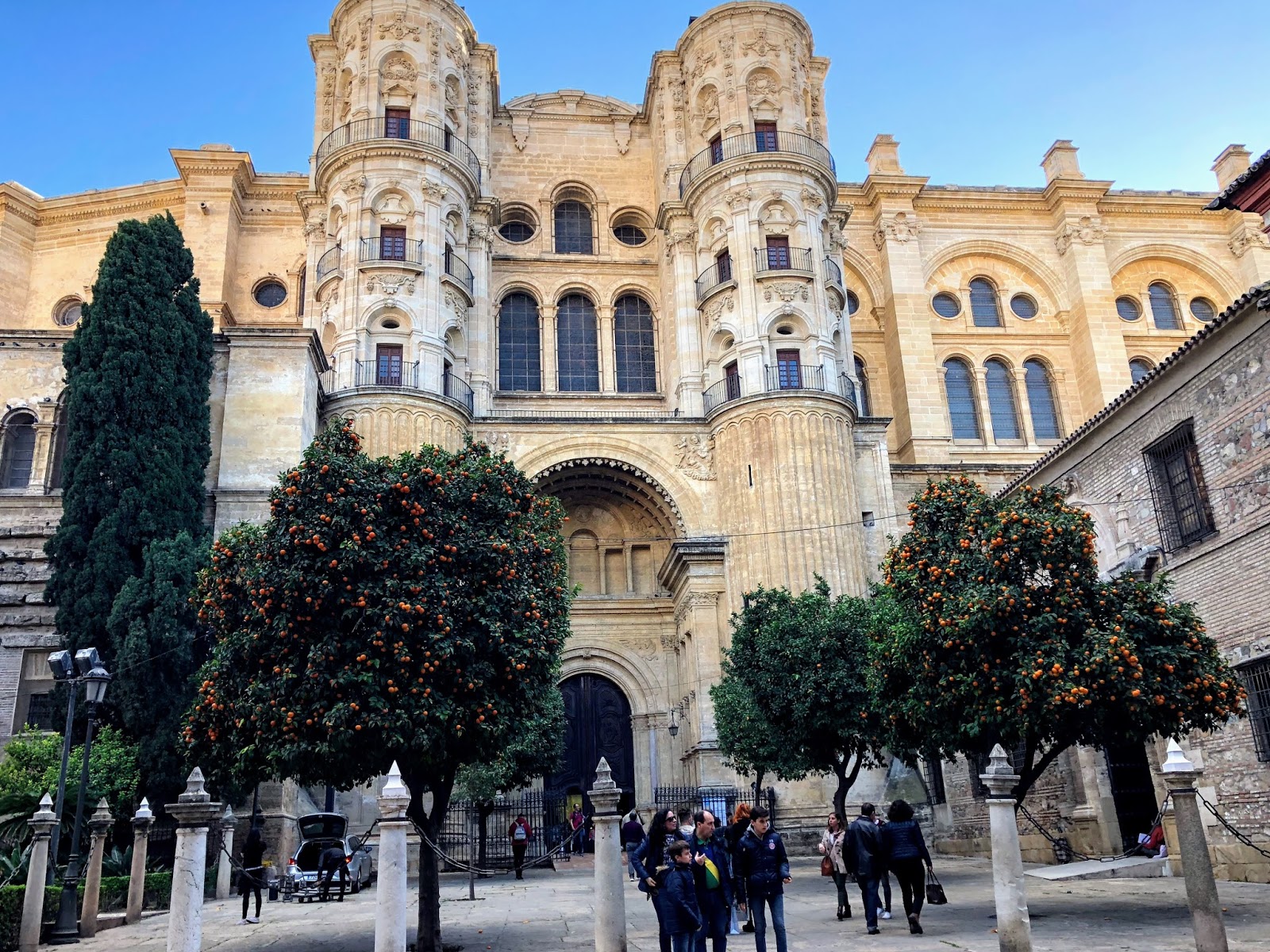
We started the trip in Malaga, Spain. We stayed there for four days, and we celebrated New Years Eve and New Years Day there. We stayed in an Airbnb that was less than ideal, but we really enjoyed the city. It was historic and really, really charming. I loved it. We spent most of our time walking the streets and eating at outdoor cafes. We visited the Malaga Cathedral, which is affectionally nicknamed "La Manquita" or "The One-Armed Lady" because one of the towers was left unbuilt. We also visited The Alcazaba of Malaga, which means "citadel" in Arabic. It is a palatial fortification built in the early 11th century, and it is stunningly large and well-maintained. We visited the Picasso Museum one day, and my favorite part was a special exhibition called "We Are Completely Free: Women Artists & Surrealism." I really enjoyed seeing that work. We spent New Years Eve wandering the city, and then we went to the Plaza de la Constitucion for the countdown. It was packed with people and surrounded by Christmas lights. It was a really exciting way to bring in the new year!

The Malaga Cathedral

Visiting the beach near the Port of Malaga
On January 2nd, after our four days in Malaga, we boarded our cruise ship, where we stayed for ten lovely days! The cruise was really great. We hit some choppy waters that didn't make us or our fellow passengers feel the best, but the staff was really wonderful and accommodating, our cabin was very comfortable, the food was good, and we really enjoyed the ship's hot tubs, lounges, and shows. We visited four Spanish ports on the cruise, and we liked them all. First, we stopped in Barcelona, and we basically did our own Antoni Gaudi tour from a hop on/ hop off bus and learned more about him than I ever knew before! My favorite spot was the outside of Casa Battlo. It was so beautiful and unique. I really liked Barcelona, although with all the gothic architecture it reminded me much more of Paris than any other Spanish city that I have been to. We also toured three of the seven Spanish Canary Islands on our ports of call. We visited Las Palmas de Gran Canaria, Santa Cruz de Tenerife, and Arrecife, Lanzarote. They were all very interesting and quaint, but we enjoyed Las Palmas the most. It had the best mix of downtown, history, and beach.

Our cruise ship

Enjoying dinner & a show onboard
One of very favorite portions of the cruise, though, was our stop in Morocco. We couldn't go to our original port of call, Casablanca, because of rocky waves and weather, so we docked in Tangier, Morocco instead. I was initially disappointed because I had been looking forward to going to Casablanca (mostly because of the movie), but our day turned out to be pretty great. We booked a full day excursion from the ship, and I'm glad we did. I think we saw the most we could in the safest way. We got on bus #5 straight from the ship, and we visited Cap Spartel, the Caves of Hercules, and then spent the rest of the day in Tetouan, Morocco. We got back to the ship at 5:45PM and it left port at 6:00PM, so that part was a little stressful, but the rest of the day was pretty great. Cap Spartel is a lighthouse located at the entrance of the Strait of Gibraltar, and the Caves of Hercules have a cut out in the rock in the shape of Northern Africa. Both were really beautiful. In Tetouan, our wonderful guide Ahmed took as all around the medina (old city), to visit mosques, an art school, a homemade goods and rugs shop, and took us for a delicious, authentic lunch complete with musicians and a dancer with burning candles on a tray on his head. Africa was Wade's fourth continent to visit, and we enjoyed our time in the historic and beautiful African cities that we were able to visit.

Nuts and spices on the street

Outside of the art school
Our trip was in turns informational, exciting, and relaxing. We were ready to come home and see our pups, but we really enjoyed our time away. We were really appreciative our travel agent, Shay Shull at Mix and Match Mama, for her help, and to the cruise staff who did a really great job hosting us. We came back ready to jump into the new year and back into our work.

Speaking of which, my spring semester has started! This semester I am teaching Technical Reporting and English 2. Both start pretty early in the morning, but I seem to have a good group of students in both classes as well. I am interested to see how the semester will play out, as I am also going to be tutoring a few hours a week in the Writing Center, which is new for me. I will be sure to report back on the progress of my classes and the tutoring this semester.

For this year, I am focusing on the word "simplicity." I am trying to figure out what that will mean in all aspects of my life, and I plan to read and mediate on the word and idea. I have some ideas of what it will look like, but I am excited for the new start and the new focus for year.

I hope that however your year started it will be a year of joy, growth, and peace. Here's to 2018!

Monday, 18 December 2017

An Instagram Story


I received this email from a student in my English 1 class after the end of the semester. So kind! 


Wednesday, 13 December 2017

Conference, Conference, Class

This semester seemed to fly past. It feels like yesterday that I was writing my example blog post for my students, "Three Pieces of My Puzzle," and publishing it here. All in all, it was actually a great semester. I was able to work with about 60 pretty awesome students, attend two really inspiring conferences, and even apply myself pretty fully to the job market. Being on the market is almost a full time job in and of itself, and I plan to write a full blog entry detailing my experience in the spring. In this blog entry, I want to talk about the two fall conferences that I attended (one academic and one non) and review my experience teaching three sections of English 1 at Madison College.

Feminisms & Rhetorics 2017

In October of this year, I traveled to Dayton, OH to present at the 11th Biennial Feminisms & Rhetorics conference. I stayed and presented with my awesome writing group, Casie Moreland and Jessica Boykin. The conference was hosted at the University of Dayton from October 4th to 7th. I was there from October 3rd to 6th and then flew home early to attend the other conference.

Like my time at Fem/Rhet in Tempe in 2015, I thoroughly enjoyed this conference. Casie, Jess, and I presented early in the conference at 1:45PM on Wednesday, Oct. 4th, the first official day presentations. We had three attendees at our panel, and after we each presented our material, we had a good conversation with those who attended about our work and future research possibilities. Our panel was called What is Past is Prologue: Women's Contributions to Rhetorics of Social Justice. On this panel, my presentation was called "'We Remain a Complex People:' Accounting for Feminist Rhetorical Practices in a Black Feminist Food Memoir." I discussed Ntozake Shange's 1998 food memoir If I Can Cook/ You Know God Can. I discussed the power of the intricacies of Shange's work, and I talked about how her work contributes to a larger group of African-American women fighting for social justice.

At the conference, I attended several other panels, including the keynote by poet Claudia Rankine. I saw friends and colleagues from Arizona State and Illinois State, as well as other conference friends. It's always a treat to reconnect with those people at conferences across the country. Casie, Jess, and I also explored Dayton a bit in our free time. I can't say it's my favorite city, but we enjoyed our time together writing, talking, and presenting. Always glad to spend time with these special friends.

Bloom Women's Retreat: A Story Unwritten

I left Feminisms & Rhetorics slightly early because I was expected back in Wisconsin for Ridgeway Church's annual Bloom women's retreat. The retreat actually ran from October 5th to 7th, but I was able to be there from the 6th to 7th. I heard the Friday evening keynote speaker Cheri Milton, and I stayed through the Saturday morning session to hear Bethany Peterson speak and then helped clean up. What I saw of the retreat and what I heard from others about it before I got there was so exciting. As part of the leadership team, I helped to plan the Friday afternoon breakout session where we asked women to share parts of their stories with each other. We had leaders positioned at every table to facilitate the conversations, and in our debrief following the retreat the team said that the women responded readily and openly in the sessions, which was so exciting to hear.

The retreat took place at Chula Vista Resort in the WI Dells, and it was cozy setting for our meetings and rooms. Even though I was only able to be part of the retreat for less than 24 hours, I knew all the work that went into the planning with my fellow leadership team members Debbie, Brittany, Bethany, Brianna, Martha, and Melissa, and I was glad to see the retreat was such a success. It was worth skipping out on the last part of Fem/Rhet, a delayed flight, running through O'Hare airport to get my connection, lost luggage, a drive through the rain, and an almost sleepless night to be there! We are already gearing up and planning for next year's retreat!

English 1 Classes

Other than that action packed week of conferencing in October, I have also been able to travel to Indiana couple times this semester and spent some time in Chicago and other parts of Illinois. Otherwise, I have been in Madison teaching my classes and job marketing. I hadn't taught the equivalent of an English 1 course since teaching at English 101 in the fall 2014 semester at Arizona State. I totally revamped the class from when I taught it at ASU, which was definitely beneficial but created extra work for me because I didn't have any previous examples of the projects to show my students. We started the semester with a fairly basic summary essay, so I wrote the example project "Surfer Girls and Sunset Memories" for my students to use as a model for the project. The next project was the rhetorical analysis blog project, which I posted here under "Three Pieces of My Puzzle." We then spent the second half of the semester focusing on the final project, which was an opinion editorial. The editorials were focused around a specific food documentary that I asked the students to watch as a group. I created an editorial called "My Dreams of Sushi" based on the 2011 food documentary Jiro Dreams of Sushi. Other than the final editorial, my students also composed annotated bibliographies (documents citing and discussing sources) and a group presentation.

From the end of the course survey, I was able to gauge my students' reactions to these three major projects, as well as the other various components of the course. Of the 53 students who filled out the survey, 23% said they liked the summary essay the best, 45% said they liked the rhetorical blog the best, and 32% said they liked the opinion editorial the best. I started the semester with 75 students, and I ended the semester with 61 students. At a community college, this is a pretty good retention rate, and I'm glad that over 80% of my students were able to stick with the course.

I ended the semester by asking each student to bring in a quote, lyric, or saying that they liked to our last class. I told them it was a chance to get some easy points as well as an opportunity to leave the course on an inspiring note. I was happily surprised by the range of readings my students brought and how they seemed to actually enjoy the activity. They brought in quotes from Mark Twain, Shakespeare, Einstein, Forrest Gump, Chance the Rapper, the Dalai Lama, Picasso, Bernie Sanders, How the Grinch Stole Christmas, Will Smith, Calvin and Hobbes, J.F.K., and three ladies read excerpts of Maya Angelou poems.

For my reading, I chose one of my all time favorite quotes. It is a conversation between Sam and Frodo, characters in J.R.R. Tolkien's epic fantasy series The Lord of the Rings. This conversation takes place as Sam and Frodo journey with the creature Smeagol/ Gollum in the middle of the three books, The Two Towers. In the book, this conversation takes place on pages 362-364, but I like the movie quote (included right) even better because it's a bit more succinct and ends with such a powerful message. I told my students if they remember nothing else from the semester that I hope they remember that "there's some good in this world... and it's worth fighting for."

I need to finish grading 25 final projects, 60 reflection letters, and submit the final grades in Blackboard, but this semester is almost all wrapped up! I plan to send the following graphic with my final email to my students, and I will leave it here as a conclusion as well.

I wish you joy and peace in this holiday season.